Geothermal energy · Singapore

From discovery to readiness

NTU's continuing geothermal journey

The initial drilling campaign has ended. The work now shifts from discovering the resource to building the knowledge, partnerships and local capability needed for the next phase of Singapore's geothermal development.

Geothermal Team · Prof. Alessandro Romagnoli · Dr. Jonathan Poh · Dr. Anurag Chidire

Watch the film
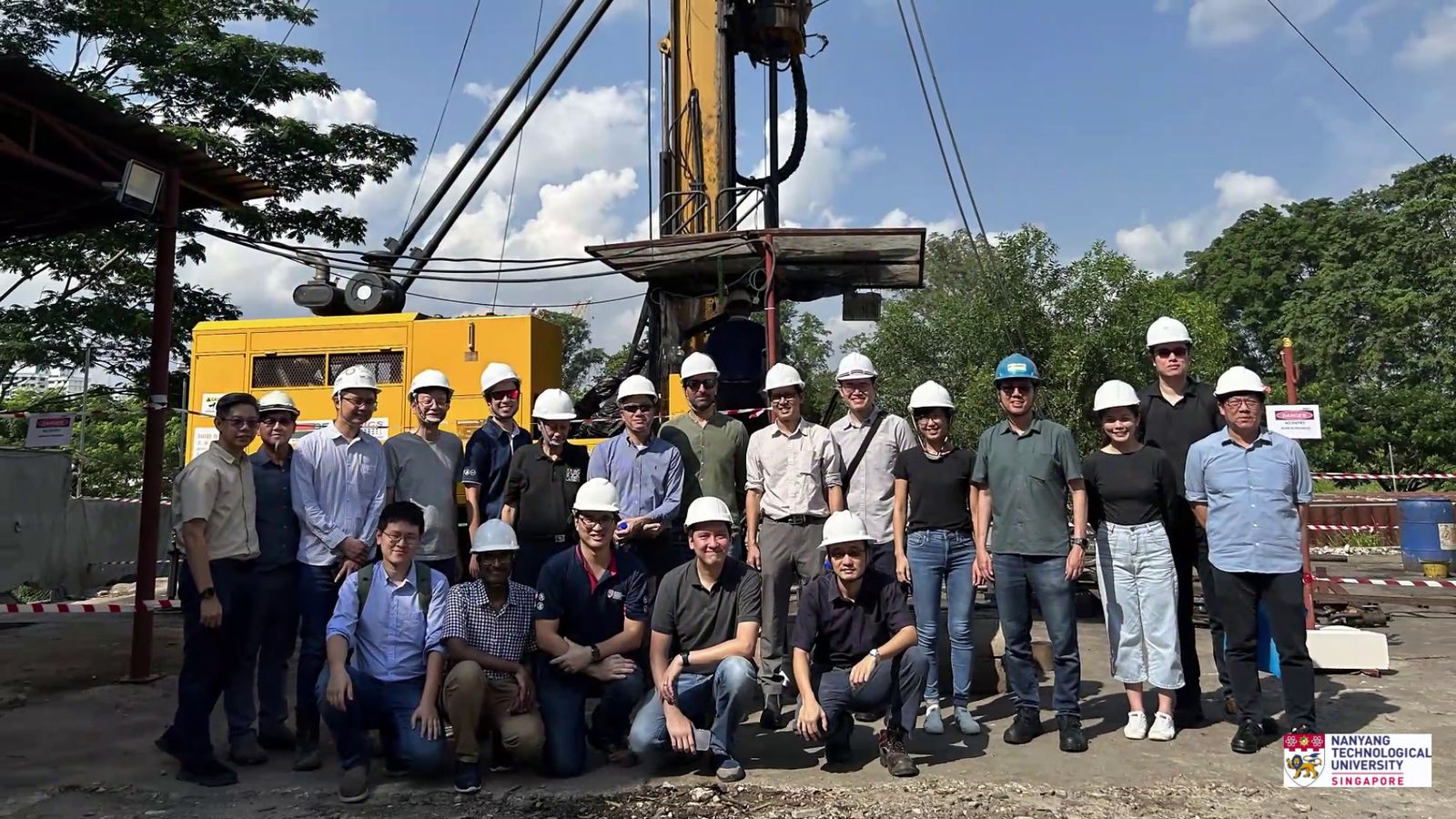
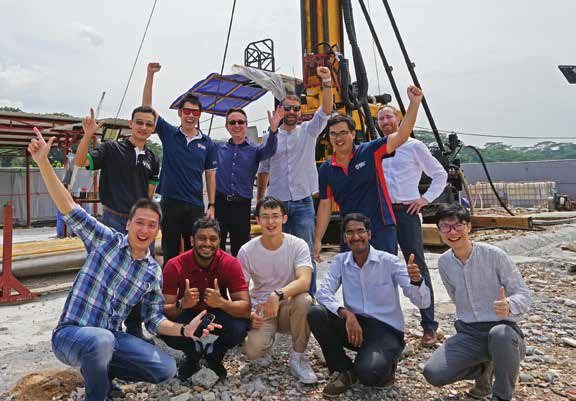
The geothermal team at the drilling site
The geothermal team and partners at the drilling site in northern Singapore.
Key findings
122°C
Measured at 1.76 km depth in the Sembawang slimhole
70°C
Measured at 1.12 km depth in the Admiralty slimhole
40–44°C/km
Evaluated geothermal gradient, about twice the global average
≈2×
Heat flow relative to the continental average

Figures as presented by the NTU geothermal team. First reported in NTU News, 4 July 2025.

Film & poster

Geothermal Energy: Unveil Singapore's First Natural Resource

The film follows the drilling campaign: site preparation, geophysical surveys, drilling, downhole temperature measurement, core recovery and site reinstatement.

English captions

Poster shown at SIEW 2026

01 · Legacy

Our legacy: a long thread of inquiry

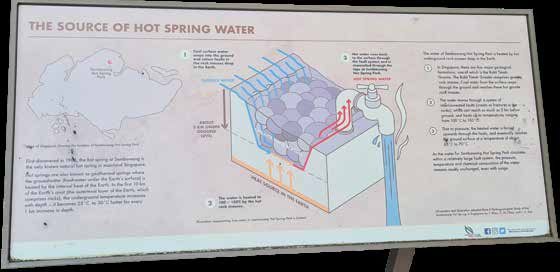
Singapore's geothermal journey began with investigations around Sembawang Hot Spring and has since progressed to deep drilling and direct subsurface evidence.

Early hydrogeological study
2002

Early hydrogeological study

Sembawang Hot Spring investigated through shallow drilling and hydrogeological studies.
First deep drilling and exploration
2021–2025

First deep drilling and exploration

Two deep exploratory slimholes drilled in northern Singapore at Admiralty and Sembawang.

National evaluation continues
Today

National evaluation continues

Singapore is undertaking further studies to evaluate its geothermal potential, including the Energy Market Authority's call for a feasibility study on the potential deployment of deep geothermal systems.
02 · Restart

What changed with the restart?

Temperature–depth profiles
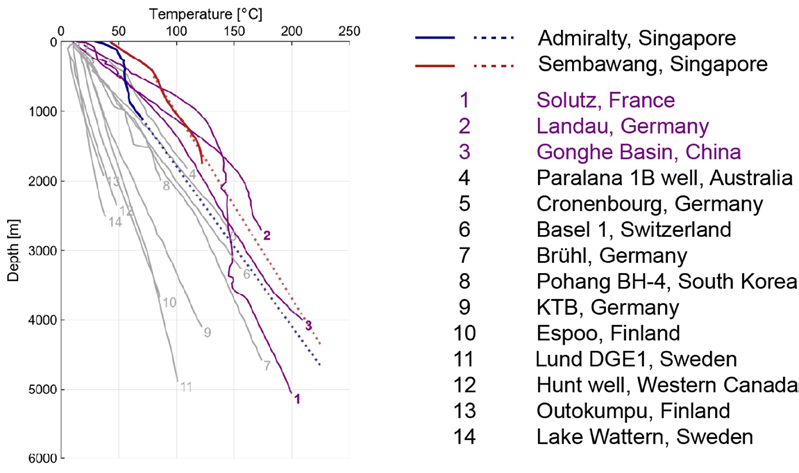
Temperature–depth profiles at Admiralty and Sembawang, compared with geothermal wells worldwide, including Soultz (France), Landau (Germany) and the Gonghe Basin (China).
Rock-quality designation and rock cores
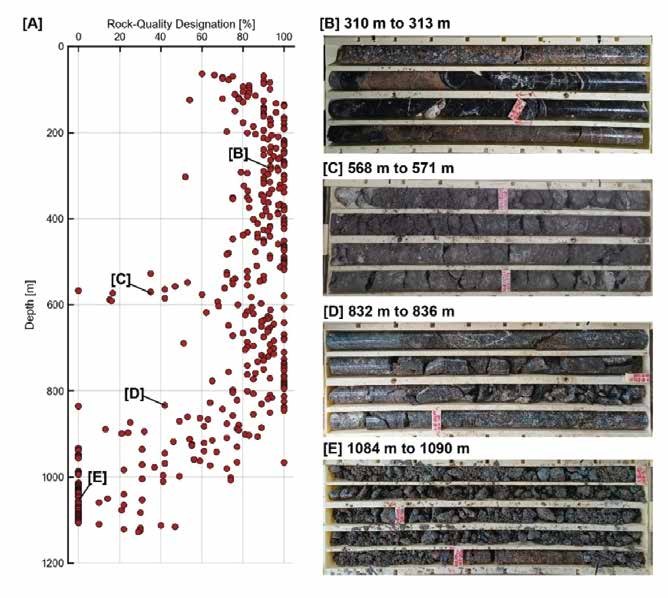
Admiralty slimhole: rock-quality designation (RQD) with depth, and core sections recovered between 310 m and 1,090 m.
1

Higher temperature than expected

Compared with most other non-volcanic regions, temperatures at Admiralty and Sembawang were found to be higher.

2

Local understanding of the subsurface

Extracted rock cores show that rock type and condition vary significantly between sites.

3

The next challenge

How could Singapore safely and effectively access and use this heat?

03 · Capability

What NTU is building now

Building capabilities to support the next phase of geothermal exploration and evaluation.

01

Understand and de-risk

Subsurface science
  • Geology and geophysics
  • Resource and temperature modelling
  • Reservoir and fracture characterisation
  • Seismicity and subsurface risk
02

Engineer and integrate

Energy systems
  • Heat extraction technologies
  • Power and cooling applications
  • Multi-energy integrated power systems
  • Techno-economic assessments
03

Connect and grow

People and ecosystem
  • Industry partnerships
  • International knowledge exchange
  • Workforce development
  • Education and public engagement
04 · Readiness

The next challenge

How could Singapore safely and effectively access and use this heat?

Geothermal development
▾
Geoscience
Drilling & surface engineering
Utilisation cases
▾
Multi-energy system integration & optimisation
▾
People & society
Environment & economics
Partners & contact

Partners and contact

Involved institutions

Supported by

Contact

Energy Research Institute @ NTU (ERI@N)
Prof. Alessandro RomagnoliGeothermal Team · Thermal Energy Systems Lab
a.romagnoli@ntu.edu.sg